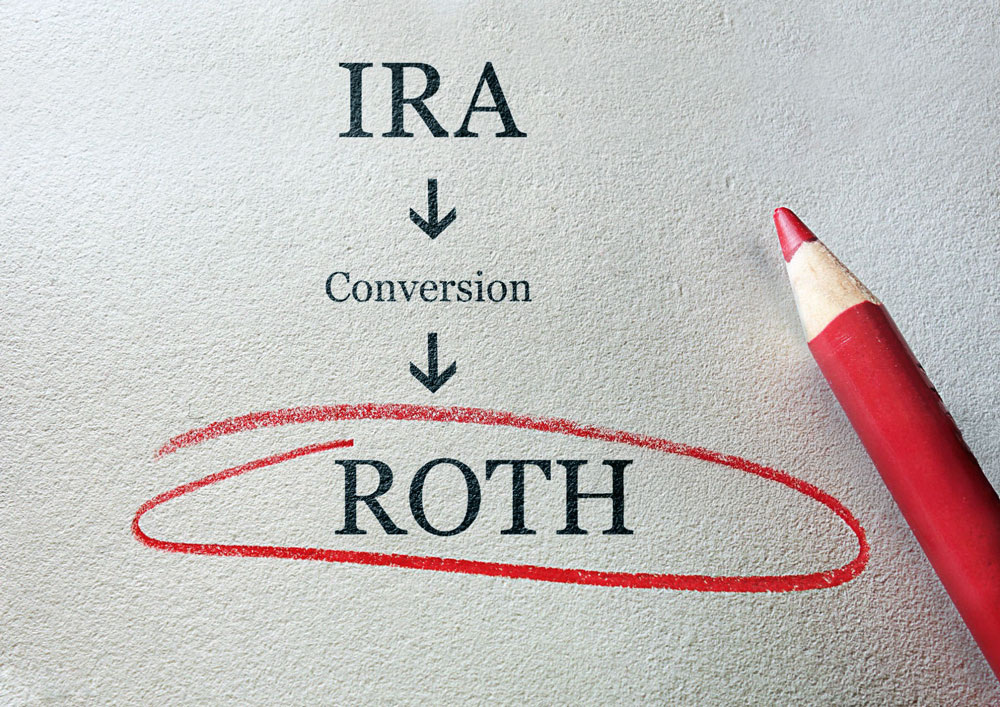
Roth conversions can be one of the most powerful tools in your tax planning toolkit. Moving money from a traditional IRA, 401(k), or Thrift Savings Plan (TSP) into a Roth allows for tax-free growth and withdrawals later.
The catch? Properly timing your conversion is everything. Get it wrong, and you could pay thousands more in taxes than necessary.
When is the best time for high-earning professionals in Northern Virginia to explore a Roth conversion? The answer depends on your tax bracket, your retirement timeline, and even your Medicare premiums. Let’s break down some key scenarios for Roth conversions into red, yellow, and green flags to help outline when a conversion makes sense—and when it doesn’t.
Scenario #1: Peak-Bracket Today, Lower Bracket Tomorrow (Red Flag)
One of the most common Roth conversion mistakes is converting during your peak earning years. For example, consider a couple filing jointly with income between $502,000 and $750,000—squarely in the 35% tax bracket. Converting at that level means locking in taxes at a premium rate.
Now imagine the same couple a few years later. They step away for an early retirement, take a sabbatical, or simply transition into a lower-paying role. Their taxable income drops below about $394,000, sliding them into the 24% bracket—that’s an 11% swing in tax cost.
Converting at 35% when you could convert at 24% isn’t just a small misstep; it’s money unnecessarily lost to taxes. To avoid this red flag, look for windows when your income and your tax bracket are lower, not higher.
Scenario #2: Paying Taxes From the IRA Itself (Yellow Flag)
A frequent Roth conversion mistake isn’t the conversion itself — it’s how the taxes on it get paid. If you use traditional IRA, 401(k), or TSP funds to cover the tax bill, you shrink the very balance you’re trying to protect, and those dollars lose years of potential tax-free compounding.
The stakes are even higher if you’re under age 59½. In that case, the dollars used to pay the tax may also be subject to a 10% early withdrawal penalty, adding insult to injury.
This scenario lands more in the yellow zone than the red, because your age, goals, and legacy plans all matter. The SECURE Act 2.0 requires most beneficiaries to drain inherited IRAs within 10 years. Every dollar of this money is taxed at ordinary income. If you have high-earning adult children, this can push their tax burden even higher. In some cases, converting and paying taxes, even out of the IRA, may still make sense. However, it is not something to do lightly — you absolutely should consult with your tax preparer and your financial advisor before moving forward in this scenario.
The bottom line: Whenever possible, pay Roth conversion taxes with money from non-retirement cash or investments.. If that’s not an option, run the numbers with an advisor before you act.
Scenario #3: IRMAA & Other Benefit Phase-Outs (Yellow Flag)
Another way Roth conversion timing can backfire is by pushing your income over key thresholds that reduce or eliminate other benefits.
The most common trap is Medicare’s IRMAA (Income-Related Monthly Adjustment Amount). Conversion income gets added to your Modified Adjusted Gross Income (MAGI). As a result, it can raise Part B and Part D premiums by thousands of dollars per year. And if you’re married, those increased premiums apply to both spouses who are on Medicare. If you’re under age 63, this isn’t a concern yet. However, once you’re within two years of Medicare enrollment, every extra dollar matters.
It is important to note that this is typically not a concern for retirees under the Federal Employee Health Benefits (FEHB) plans. For everyone else on Medicare, it is a significant consideration.
For all taxpayers, conversions can also trigger phase-outs for child tax credits, ACA subsidies, qualified business-income deductions, SALT deductions, or net investment-income taxes. In some cases, this translates into a significant tax hit, which ultimately undermines what is supposed to be a long-term advantage.
Scenario #4: Short Time Horizon (Yellow Flag) or Charity-Bound Funds (Red Flag)
Roth conversions typically only pay off if the dollars stay invested long enough to overcome the upfront tax cost. If you’ll need the money within 5 to 10 years, the math often doesn’t work. On top of that, the five-year rule Roth conversion requires converted funds to remain untouched for five years. This five-year rule on conversions does not apply if you are over 59 ½ when you make the withdrawal.
Charitable giving is another case where converting can backfire. Once you reach age 70½, Qualified Charitable Distributions (QCDs) allow you to donate directly from your IRA. Those gifts count as tax-free to the charity and don’t count towards your taxable income, even if you don’t itemize. For more on QCDs, check out my earlier piece on taxable income. If you plan to donate to charity, keeping them in a traditional IRA is often the most efficient approach to philanthropy. In this situation, a Roth conversion could actually erase one of your best tax benefits.
Green Flag Scenarios: When a Roth Conversion Can Work in Your Favor
Not every situation is a stop sign. There are times when conversions are a smart play:
- Moderate Tax Brackets (22%–24%): Conversions in this range often balance today’s tax cost with tomorrow’s tax-free growth. Historically low brackets make this a sweet spot for many families.
- Extended Unemployment or Reduced Earnings: If you find yourself in a lower bracket due to a sabbatical, job change, or reduced hours, partial conversions can make sense.
- Young Professionals Early in Their Career: Even if conversions aren’t ideal, using Roth 401(k) or Roth TSP contributions can set the stage for long-term tax-free growth while your rates are low.
The key is knowing your tax bracket, your timeline, and your legacy goals. Roth conversions should always be viewed as part of lifetime tax planning, not just a one-year move.
Quick Self-Check Mini-Quiz
| Question | Why It Matters | |
| 1 | My current marginal tax bracket is 32 % or higher, and I expect it to be lower within the next five years (e.g., sabbatical, early retirement, career change). | Converting in a peak-tax year can lock in an avoidable premium due to higher marginal tax rates. |
| 2 | I would have to pay the conversion tax out of the IRA (or other retirement funds), not with separate cash. | Using retirement dollars shrinks the balance and may trigger the five-year payout clock. If you convert, plan on not touching it until you’re at least 59½ to avoid a potential 10% early withdrawal penalty. |
| 3 | I’m within two years of enrolling in Medicare—or already enrolled—so extra income could raise Roth conversion IRMAA surcharge premiums. | Conversions can increase MAGI and can add $1,000s per year in Part B & D costs per spouse. |
| 4 | I plan to use or gift these funds within 5–10 years. | Short time horizons limit growth. |
| 5 | I plan to leave them to charities or lower-bracket heirs. | Charities can receive traditional IRA dollars tax-free through QCDs. |
| 6 | A large conversion would push my income over phase-out thresholds (child-tax credit, expanded SALT, deduction under OBBBA, ACA subsidies, QBI deduction, NIIT, etc.). SALT: State and Local Tax OBBBA: One Big Beautiful Bill Act ACA: Affordable Care Act QBI: Qualified Business Income NIIT: Net Investment Income Tax | Crossing cliffs can wipe out the benefits of conversion. Plan over multiple years instead. |
Smart Planning Prevents Roth Conversion Mistakes
A lot of people rush into conversions because they read about it online or heard it from a friend. Then they find themselves paying 35% in taxes when their retirement income would have landed them in the 24% bracket, proving that timing is everything.
Ready to know exactly where you stand? Book a complimentary 15-minute Roth Timing Review. In just one conversation, you’ll see how a conversion fits, or doesn’t fit, your overall plan.
Traditional IRA account owners have considerations to make before performing a Roth IRA conversion. These primarily include income tax consequences on the converted amount in the year of conversion, withdrawal limitations from a Roth IRA, and income limitations for future contributions to a Roth IRA. In addition, if you are required to take a required minimum distribution (RMD) in the year you convert, you must do so before converting to a Roth IRA. show less